
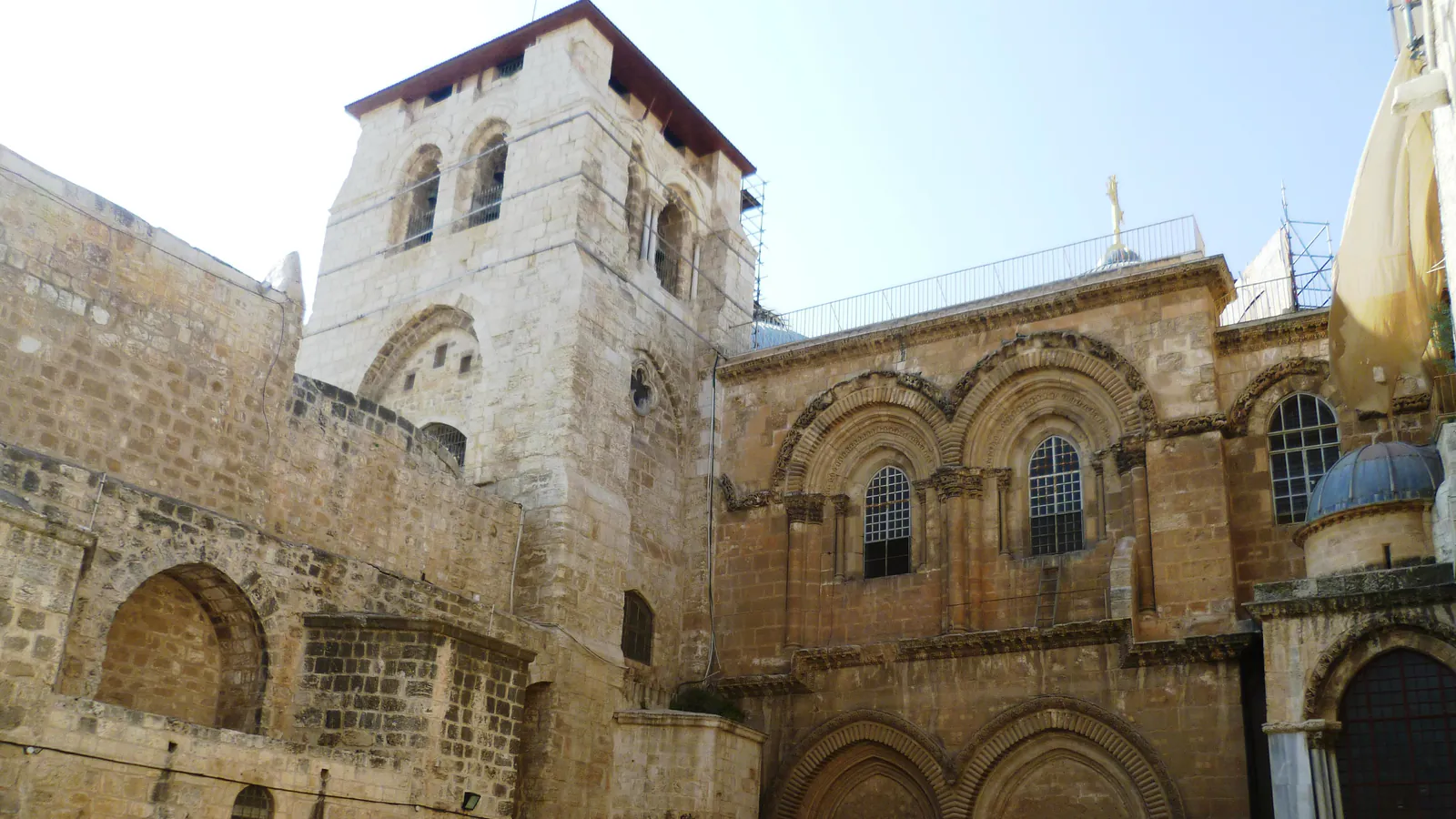
- Location
- Jerusalem
- Period
- From the fourth century
A brief timeline
After Roman building on the site, Constantine’s complex was dedicated in 335 with the tomb at the center of the Anastasis. War, fire, and rebuilding altered its form; today’s structure carries layers from Byzantine and Crusader periods.
Architecture and art
The church is a sequence of places rather than a symmetrical axis: Golgotha, the Stone of Anointing, the Anastasis rotunda, and the tomb’s Edicule. Its overlapping fabric reflects Jerusalem’s complex history and the presence of several Christian traditions.
A living church
Roman Catholics, Greek Orthodox, and Armenian Apostolic Christians share principal responsibilities, while other communities also hold worship rights. The rhythm can be complex, yet it expresses a central truth: the church is preserved first to celebrate the Paschal mystery.
If you visit, remember that this is first a place of worship: check the official liturgical schedule, keep silence, and respect the local community.